
Formalin-fixed, paraffin-embedded tissue is one of the most widely used biospecimen formats in oncology research, biomarker development, translational medicine, and diagnostic assay validation. Researchers increasingly require FFPE tissue blocks representing different cancer stages to understand how tumor biology, immune-cell composition, protein expression, and the tumor microenvironment change during disease progression.
Multiplex immunohistochemistry, commonly known as multiplex IHC, allows researchers to evaluate several biomarkers simultaneously within a single tissue section. Unlike conventional single-marker IHC, multiplex IHC can reveal the spatial relationships between tumor cells, immune cells, stromal components, and therapeutic targets.
Access to high-quality FFPE blocks from early-stage, locally advanced, and metastatic tumors can support comparative studies across the full disease spectrum. Carefully selected samples with confirmed diagnosis, tumor-stage information, pathology reports, and relevant clinical annotations help improve study reliability and reduce the time required for specimen screening.
Buy FFPE Tissue Blocks by Cancer Stage
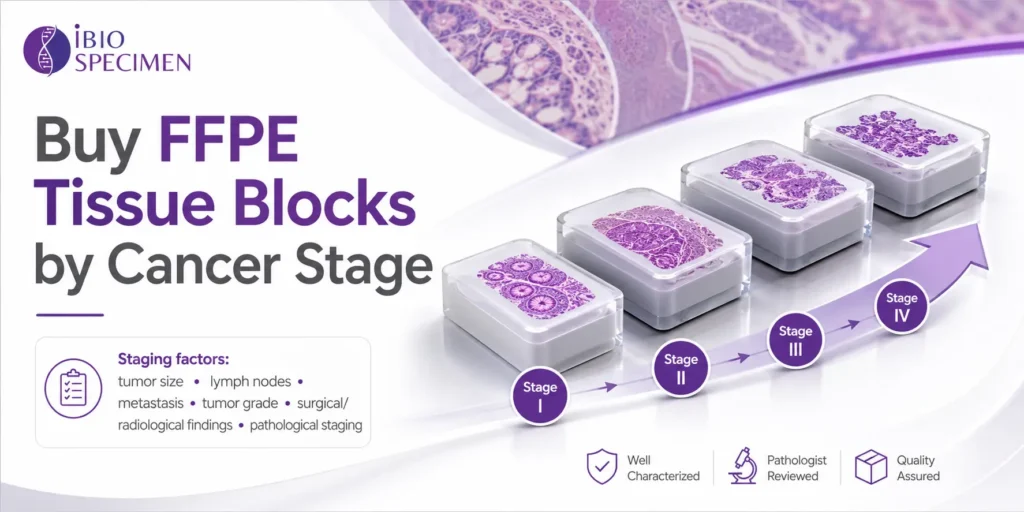
Researchers looking to buy FFPE tissue blocks by cancer stage should consider whether the samples are classified using an internationally recognised staging system, such as the American Joint Committee on Cancer TNM classification.
Cancer stage may be determined using several factors, including:
- Primary tumor size and local invasion
- Regional lymph-node involvement
- Presence or absence of distant metastasis
- Histological diagnosis and tumor grade
- Surgical and radiological findings
- Pathological staging information
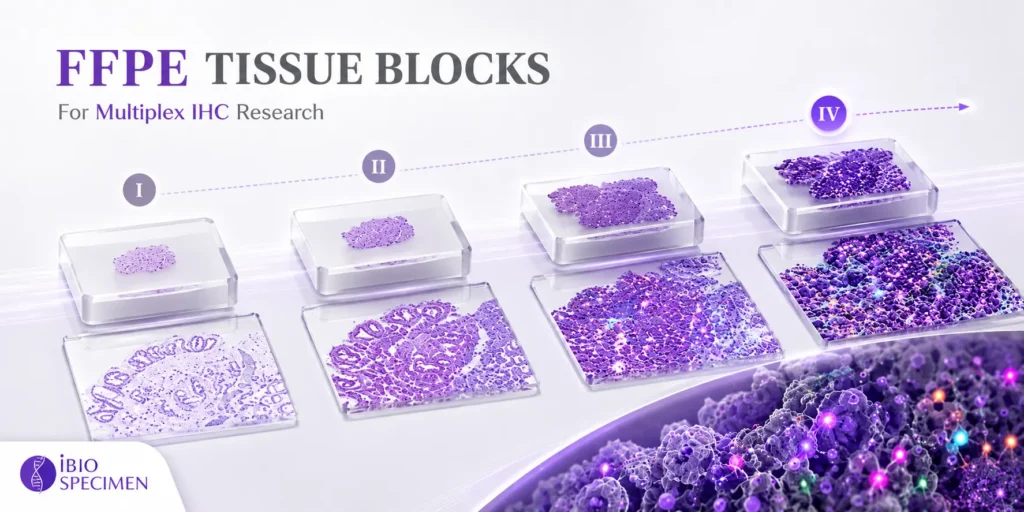
FFPE blocks from Stage I tumors can help researchers investigate early molecular alterations and immune responses. Stage II and Stage III samples may support the assessment of local invasion, lymph-node involvement, and changes in the tumor microenvironment. Stage IV tumors can be useful for studying metastatic progression, immune evasion, treatment resistance, and advanced-disease biomarkers.
When sourcing stage-specific FFPE blocks, researchers should request pathology-confirmed staging data whenever available. If only clinical staging is available, this should be clearly identified in the specimen manifest.
FFPE Tissue Blocks for Multiplex IHC
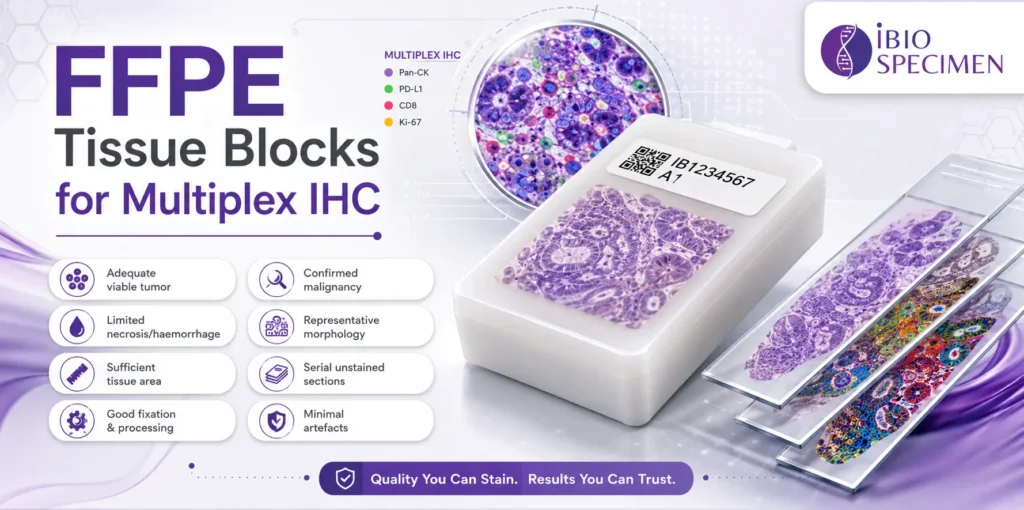
FFPE tissue blocks for multiplex IHC must have adequate tissue quality, tumor content, and antigen preservation. Multiplex staining protocols can involve repeated cycles of antibody incubation, fluorophore deposition, imaging, and signal removal. Poorly processed or exhausted tissue blocks may not perform consistently throughout these workflows.
Important sample-selection considerations include:
- Adequate viable tumor percentage
- Limited necrosis and haemorrhage
- Sufficient tissue surface area
- Good fixation and processing quality
- Confirmed malignant diagnosis
- Representative tumor morphology
- Availability of serial unstained sections
- Minimal tissue-folding or sectioning artefacts
The ideal block should contain enough tissue to support assay optimisation, antibody-panel development, control staining, repeat testing, and image analysis.
Multiplex IHC studies may examine tumor cells alongside CD3-positive T cells, CD8-positive cytotoxic T cells, CD4-positive helper T cells, FOXP3-positive regulatory T cells, CD68-positive macrophages, CD163-positive macrophages, B cells, dendritic cells, and additional stromal or immune populations.
Purchase Staged Tumor FFPE Blocks
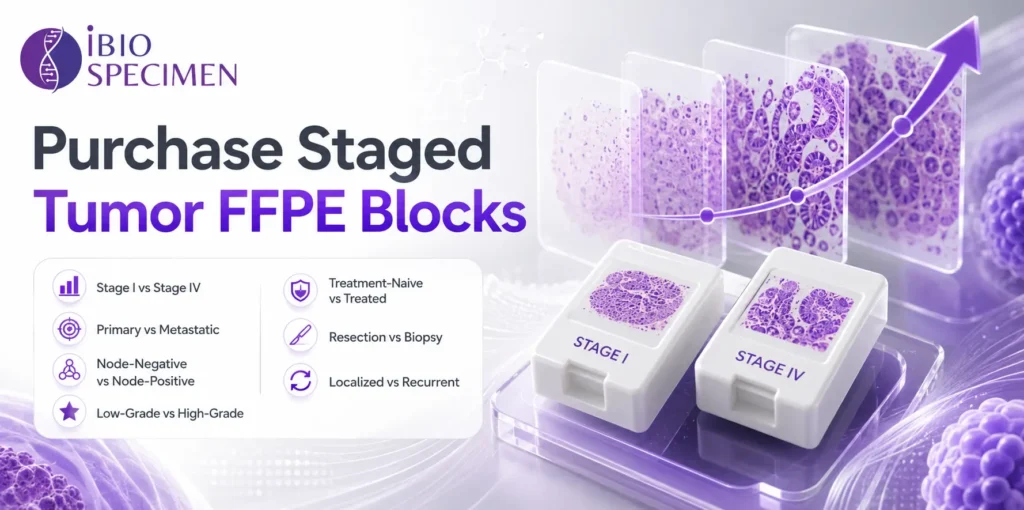
Investigators who purchase staged tumor FFPE blocks can compare biomarker expression across different phases of cancer progression. This is particularly useful when studying biomarkers that may be expressed differently in early and advanced disease.
For example, a study may compare:
- Stage I versus Stage IV immune-cell infiltration
- Primary tumors versus matched metastatic lesions
- Node-negative versus node-positive tumors
- Low-grade versus high-grade malignancies
- Treatment-naive versus previously treated samples
- Resected tumors versus biopsy specimens
- Localised disease versus recurrent disease
A balanced cohort should ideally include sufficient cases from each stage. However, the availability of particular stages depends on the cancer type. Early-stage cancers are often represented by surgical resections, while advanced cancers may be represented by core biopsies or metastatic-site samples.
Researchers should define the acceptable specimen type, tumor location, disease stage, sample age, and tissue requirements before procurement begins.
Order FFPE Cancer Tissue Blocks
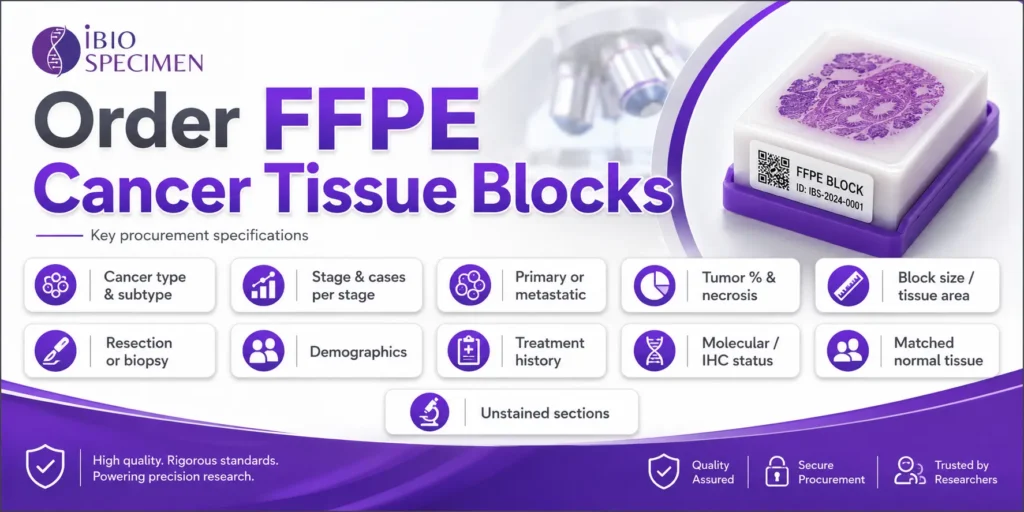
Before researchers order FFPE cancer tissue blocks, they should prepare detailed inclusion and exclusion criteria. Clear specifications help a biospecimen supplier identify suitable cases and minimise the risk of unsuitable samples being delivered.
A procurement request may include:
- Cancer type and histological subtype
- Required cancer stages
- Number of cases per stage
- Primary or metastatic tissue
- Tumor percentage requirement
- Maximum allowable necrosis
- Block dimensions or tissue area
- Resection or biopsy preference
- Required demographic information
- Treatment-history requirements
- Molecular or IHC biomarker status
- Availability of matched normal tissue
- Number and thickness of unstained sections
Researchers should also clarify whether complete FFPE blocks, tissue curls, unstained slides, tissue microarrays, or digital whole-slide images are required.
FFPE Tissue Blocks for Sale
FFPE tissue blocks for sale may be available as complete paraffin blocks, scrolls, cores, unstained slides, or tissue microarrays. Complete blocks usually provide the greatest flexibility because researchers can determine the section thickness, prepare additional slides, and perform repeated staining.
However, the sale and transfer of human tissue must follow applicable ethical, institutional, and legal requirements. Tissue should be collected under an approved protocol with appropriate consent or a valid waiver of consent, depending on local regulations and the nature of the collection.
High-quality FFPE tissue sourcing should involve:
- Ethical review or institutional approval
- De-identification of donor information
- Controlled sample storage
- Documented pathology review
- Chain-of-custody procedures
- Secure clinical-data handling
- Compliance with applicable privacy requirements
- Research-use-only documentation
Pricing may vary according to cancer rarity, stage, annotation depth, tissue size, molecular characterisation, matched-sample availability, and required laboratory testing.
Multiplex IHC FFPE Samples Supplier
A reliable multiplex IHC FFPE samples supplier should be able to provide more than tissue alone. The supplier should understand the technical requirements of multiplex immunohistochemistry and help researchers select blocks likely to perform well in complex staining workflows.
Supplier capabilities may include:
- Pathologist review of every selected case
- Confirmation of viable tumor percentage
- Review of necrosis and tissue quality
- Preparation of fresh unstained slides
- H&E slide provision
- Digital slide scanning
- Macrodissection or tissue marking
- IHC prescreening
- Molecular biomarker testing
- Custom cohort development
- Prospective tissue collection
The supplier should also communicate whether the tissue was fixed using neutral-buffered formalin, whether fixation duration is known, and whether decalcification or other pre-analytical treatments were performed. Decalcified tissues, particularly bone metastases, may show reduced antigenicity and may require separate assay optimisation.
Clinically Annotated FFPE Tissue Blocks

Clinically annotated FFPE tissue blocks can substantially increase the scientific value of a multiplex IHC study. Clinical annotations help researchers interpret staining results in relation to disease behaviour, treatment exposure, and patient outcomes.
Depending on availability and consent, annotations may include:
- Age range
- Sex
- Diagnosis
- Histological subtype
- Tumor grade
- Pathological stage
- Clinical stage
- Primary tumor site
- Metastatic site
- Lymph-node status
- Treatment history
- Recurrence status
- Follow-up information
- Survival data
- Molecular biomarker status
Researchers should distinguish between essential and optional clinical data. Requiring excessive annotation may reduce sample availability and increase procurement time and cost. A tiered approach can be useful, with core data required for all specimens and extended data requested where available.
FFPE Blocks With Tumor Staging Data
FFPE blocks with tumor staging data allow investigators to create clearly defined disease-progression cohorts. Stage information should ideally be supported by pathology records, operative findings, imaging reports, or clinical summaries.
The TNM classification typically describes:
- T: Extent and size of the primary tumor
- N: Involvement of regional lymph nodes
- M: Presence of distant metastasis
Researchers should confirm which edition of the staging system was used, particularly when combining historical and recently collected specimens. Staging definitions can change over time, and cases classified using different editions may not be directly comparable.
For retrospective studies, some records may contain incomplete staging information. In such situations, a pathologist or qualified clinical reviewer may be able to reconstruct the stage using available pathology and clinical data, although reconstructed staging should be identified separately from originally documented staging.
Human Cancer FFPE Blocks for Research
Human cancer FFPE blocks for research are used in immuno-oncology, drug discovery, antibody development, companion-diagnostic research, assay validation, and artificial-intelligence studies.
Common cancer indications requested for multiplex IHC include:
- Breast cancer
- Non-small cell lung cancer
- Colorectal cancer
- Gastric cancer
- Pancreatic cancer
- Ovarian cancer
- Prostate cancer
- Melanoma
- Head and neck cancer
- Renal cell carcinoma
- Hepatocellular carcinoma
- Endometrial cancer
- Urothelial carcinoma
- Cholangiocarcinoma
- Soft-tissue sarcoma
Each cancer type has distinct immune and stromal characteristics. For example, colorectal cancer studies may focus on mismatch-repair status and immune-cell density, while breast cancer studies may compare hormone-receptor-positive, HER2-positive, and triple-negative disease.
FFPE Tissue Blocks for Biomarker Studies
FFPE tissue blocks for biomarker studies can support the discovery, verification, and validation of protein-based biomarkers. Multiplex IHC is especially valuable when biomarker significance depends on cellular location or proximity to other cell populations.
A marker may have different biological implications depending on whether it is expressed by:
- Tumor cells
- Tumor-infiltrating lymphocytes
- Macrophages
- Fibroblasts
- Endothelial cells
- Stromal cells
- Cells at the invasive margin
- Cells within tertiary lymphoid structures
Multiplex IHC can also measure the distance between immune cells and tumor cells, identify immune-excluded or immune-infiltrated phenotypes, and characterise immune-cell neighbourhoods.
Potential biomarker panels may include PD-L1, PD-1, CD3, CD4, CD8, FOXP3, CD20, CD68, CD163, pan-cytokeratin, Ki-67, granzyme B, LAG-3, TIM-3, TIGIT, VISTA, IDO1, HER2, ER, PR, and other disease-specific targets.
Custom FFPE Tissue Procurement Services
Custom FFPE tissue procurement services are useful when required cases are not immediately available in existing inventories. A custom project may involve retrospective archive screening, prospective sample collection, laboratory prescreening, or a combination of these approaches.
The procurement process may include:
- Review of the study protocol and inclusion criteria
- Identification of participating hospitals or pathology laboratories
- Ethics and contractual review
- Database or archive screening
- Pathology confirmation
- Block-quality assessment
- Biomarker prescreening
- Clinical-data collection
- Specimen preparation
- Quality-control review and shipment
Custom procurement may be required for rare cancers, specific molecular alterations, unusual metastatic sites, uncommon disease stages, or highly defined treatment histories.
Researchers should allow sufficient flexibility in their criteria when possible. Extremely restrictive requirements can substantially reduce feasibility, particularly when multiple rare characteristics are combined.
FFPE Tumor Blocks for Multiplex Immunohistochemistry
FFPE tumor blocks for multiplex immunohistochemistry should be assessed for pre-analytical variables that can affect antigen detection. Formalin fixation stabilises tissue architecture, but prolonged or insufficient fixation can alter epitope availability.
Relevant factors include:
- Time from tissue removal to fixation
- Formalin concentration
- Fixation duration
- Tissue thickness during fixation
- Processing temperature
- Paraffin quality
- Storage duration
- Exposure to heat or moisture
- Decalcification procedures
Although complete fixation data may not be available for older archival specimens, consistent pathology quality and successful control staining can help determine suitability.
Pilot testing is recommended before applying a large multiplex panel to an entire cohort. A small representative set from different stages can be used to optimise antigen retrieval, antibody concentration, fluorophore selection, imaging parameters, and spectral unmixing.
Bulk FFPE Tissue Blocks Supplier
A bulk FFPE tissue blocks supplier can support large retrospective studies, multi-cancer biomarker programmes, assay-validation projects, and artificial-intelligence development. Bulk sourcing requires strong specimen-management systems to maintain consistency across hundreds or thousands of samples.
For large projects, researchers should request a preliminary feasibility assessment and specimen manifest before finalising the order. The manifest may include diagnosis, stage, grade, tissue type, tumor percentage, necrosis, specimen year, biomarker status, and available material.
Bulk projects may be delivered in batches to support ongoing laboratory work. Batch delivery allows researchers to review the first group of samples, identify potential quality concerns, and refine the criteria before the remaining specimens are prepared.
Quality standards should remain consistent across all batches. A documented replacement policy may also be helpful if a block fails pathology review or does not contain the expected amount of viable tumor.
Stage-Specific Oncology FFPE Samples
Stage-specific oncology FFPE samples enable researchers to investigate how biomarker patterns evolve from early disease to advanced cancer. These samples are valuable for identifying biomarkers associated with invasion, nodal spread, metastasis, recurrence, and treatment resistance.
An ideal stage-specific study may include:
- Stage I localised tumors
- Stage II locally invasive tumors
- Stage III node-positive or locally advanced tumors
- Stage IV metastatic tumors
- Adjacent normal tissue
- Benign disease controls
- Primary-metastatic matched pairs
- Pre-treatment and post-treatment matched samples
Matched samples are particularly valuable because they reduce inter-patient biological variation. However, matched longitudinal tissue sets are uncommon and may require custom prospective collection or detailed retrospective archive searches.
When matched samples are unavailable, researchers can use carefully balanced independent cohorts. Cases should be matched as closely as possible for age, sex, histological subtype, tumor grade, treatment status, and other relevant variables.
Ethically Sourced FFPE Tissue Blocks
Ethically sourced FFPE tissue blocks are essential for credible and compliant biomedical research. Ethical sourcing protects donor privacy, supports responsible tissue use, and helps research sponsors meet institutional and regulatory expectations.
Researchers should verify that specimens are:
- Collected under an approved ethical framework
- Used in accordance with informed consent or a valid waiver
- De-identified before transfer
- Accompanied by permitted clinical information
- Stored and transported securely
- Used only for the agreed research purpose
- Covered by appropriate material-transfer documentation
Ethical sourcing is particularly important for projects involving genomic analysis, artificial intelligence, extensive clinical annotation, or international specimen transfer. Agreements should define permitted uses, publication rights, intellectual-property expectations, data protection, and restrictions on re-identification.
Importance of Pathology Quality Control
Pathology quality control is one of the most important stages of FFPE specimen procurement. A qualified pathologist should verify the diagnosis, assess tumor content, estimate necrosis, and confirm that the block is representative of the required disease stage.
A fresh H&E slide is often prepared from each block before shipment. The H&E slide can be digitally scanned and reviewed remotely by the study sponsor. Tumor regions may also be marked for macrodissection or image-analysis correlation.
For multiplex IHC, pathology review can help identify:
- Tumor-rich regions
- Immune-cell-rich regions
- Necrotic areas
- Stromal compartments
- Invasive margins
- Lymphoid aggregates
- Tissue-folding or crushing artefacts
- Areas unsuitable for analysis
This information can improve slide selection, image acquisition, and downstream quantitative analysis.
Using Different Cancer Stages in Multiplex IHC Studies
A well-designed stage-based multiplex IHC study should begin with a clearly defined scientific question. The panel composition and cohort structure should reflect the biological mechanism being investigated.
For example, researchers studying immune escape may compare PD-L1 expression, CD8 infiltration, macrophage density, and regulatory T-cell populations across Stage I to Stage IV tumors. Researchers investigating metastasis may compare epithelial, mesenchymal, vascular, and immune markers between primary tumors and metastatic sites.
The study design should consider potential confounding factors, including treatment exposure, specimen age, tissue type, fixation differences, and molecular subtype.
Adequate sample numbers are required because biomarker expression can vary considerably between patients. Statistical planning should be completed before specimen procurement whenever possible.
Selecting the Right FFPE Tissue Format
Complete FFPE blocks provide flexibility, but other formats may be more appropriate for particular projects.
Unstained slides are convenient for immediate staining but have a limited usable storage period, especially for sensitive antigens. Tissue microarrays allow many samples to be analysed on a single slide but may not capture intratumoral heterogeneity. Tissue curls are useful for molecular studies but do not preserve spatial information.
For multiplex IHC, complete FFPE blocks or freshly cut unstained sections are generally preferred. Serial sections can also be used to compare multiplex staining with single-marker IHC, H&E morphology, in situ hybridisation, or spatial-transcriptomic data.
Conclusion
FFPE tissue blocks representing different cancer stages provide an important foundation for multiplex IHC, immuno-oncology, biomarker discovery, drug development, and translational research.
High-quality research requires more than identifying a cancer diagnosis. Researchers should consider stage, grade, tumor percentage, necrosis, fixation, clinical annotation, molecular subtype, treatment history, and tissue availability.
Working with an experienced biospecimen provider can help investigators obtain clinically annotated, pathology-reviewed, stage-specific tissue suitable for complex immunohistochemistry workflows. Whether a study requires a small pilot cohort, a rare-cancer collection, matched primary and metastatic samples, or hundreds of blocks across multiple disease stages, carefully planned procurement can improve data quality and reduce study delays.
By selecting ethically sourced FFPE tissue with reliable staging information and adequate material, researchers can generate more meaningful insights into tumor progression, immune biology, therapeutic response, and biomarker expression.