
Whole Blood
Human Whole Blood Samples for Research
Human Whole Blood Samples Provider In U.S.A and United Kingdom
iBioSpecimen provides high-quality human whole blood samples from healthy and diseased donors worldwide for biomedical research, clinical studies, assay development, genomics, molecular diagnostics, pharmaceutical R&D, and medical device validation. Through our global biospecimen sourcing network, researchers can access fresh whole blood samples, banked whole blood specimens, leftover clinical blood samples, and disease-specific blood specimens collected through hospitals, laboratories, blood centers, clinics, and research partners across the United States, Europe, Asia, and other international regions.
Our human whole blood samples for research are suitable for a wide range of applications, including genetic research, liquid biopsy studies, biomarker discovery, IVD assay development, immunology research, oncology research, infectious disease studies, blood-based diagnostics, and drug development programs. iBioSpecimen supports pharmaceutical companies, biotech firms, CROs, diagnostic manufacturers, academic researchers, and medical device companies with reliable access to healthy donor blood samples and diseased donor whole blood specimens based on specific study requirements.
What Are Human Whole Blood Samples?
Human whole blood samples are unseparated blood specimens containing:
- Red blood cells (RBCs)
- White blood cells (WBCs)
- Platelets
- Plasma
- Circulating biomarkers
- Genomic DNA and cellular material
Whole blood is widely used because it preserves the native composition of blood, making it highly valuable for clinical and research applications.
Applications of Human Whole Blood Samples
Applications of Human Whole Blood Samples
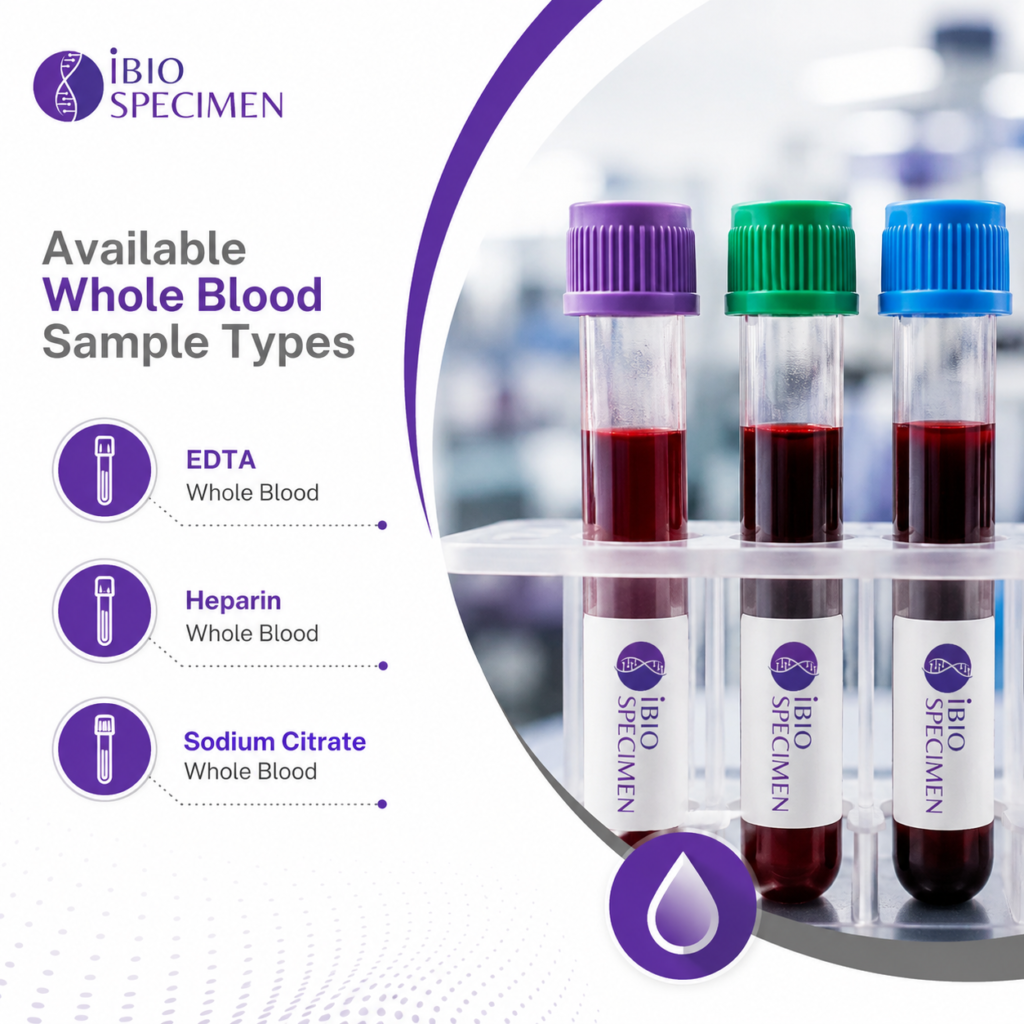
Available Whole Blood Sample Types
We provide access to multiple specimen formats, including:
- Fresh whole blood samples
- Banked frozen whole blood
- Leftover clinical whole blood
- EDTA whole blood
- Heparin whole blood
- Sodium citrate whole blood
- PAXgene blood tubes
- DNA stabilized blood samples
- RNA stabilized blood samples
- Matched serial blood collections
- Longitudinal blood collections
Disease State Whole Blood Samples
Oncology Samples
• Breast cancer
• Lung cancer
• Colon cancer
• Prostate cancer
• Leukemia
• Lymphoma
• Ovarian cancer
• Pancreatic cancer
Autoimmune Diseases
• Lupus
• Rheumatoid arthritis
• Psoriasis
• Multiple sclerosis
Metabolic Disorders
• Diabetes Type 1
• Diabetes Type 2
• Obesity
• Metabolic syndrome
Infectious Diseases
• Viral infections
• Bacterial infections
• Hepatitis
• HIV (where permitted and compliant)
• COVID-related collections
Cardiovascular Conditions
• Hypertension
• Coronary artery disease
• Heart failure
Healthy Donor Whole Blood Samples
In addition to diseased donors, we provide healthy control whole blood samples from screened donors for comparative studies, assay controls, and baseline population research.
Available filters may include:
- Age groups
- Gender
- Ethnicity
- Smoking status
- BMI range
- Medication history
- Fasting status
Why Choose iBioSpecimen for Whole Blood Samples?
Applications of Human Whole Blood Samples
Find the Right Whole Blood Match
The iBioSpecimen marketplace enables researchers to request samples matching precise donor criteria:
- Disease diagnosis
- Stage or severity
- Treatment status
- Age and gender
- Race / ethnicity
- Smoking history
- Family history
- Medication exposure
- Lab results
- Follow-up outcomes
Request a Quote for Human Whole Blood Samples
Need fresh or banked Human Whole Blood Samples for research, diagnostics, or product development? Contact iBioSpecimen for fast feasibility and custom sourcing support.
We help deliver the right biospecimens, right on time. Email Us at : info@ibiospecimen.com
iBioSpecimen offers customized access to high-quality human whole blood samples for research, diagnostic development, pharmaceutical studies, biomarker programs, genomics, immunology, liquid biopsy development, and clinical assay validation. We support researchers, diagnostic companies, CROs, pharmaceutical companies, biotechnology firms, academic institutions, and medical device developers looking for human whole blood samples in the USA, UK, Europe, Asia, and other international regions. Our whole blood sourcing service is designed for organizations that require reliable human blood specimens from healthy donors, disease-state donors, and study-specific patient populations.
Through our global biospecimen sourcing network, iBioSpecimen helps research teams obtain fresh human whole blood samples, healthy donor whole blood, diseased donor whole blood, residual clinical blood samples, banked whole blood specimens, and prospectively collected whole blood samples based on defined scientific, clinical, logistical, and pre-analytical requirements. Whether your organization is based in the United States, United Kingdom, Europe, or another international market, we can help source whole blood samples aligned with your research protocol and project timeline.
Human whole blood is a highly valuable biospecimen because it represents a complete circulating biological system. Unlike isolated serum or plasma, whole blood contains cellular and non-cellular components, including red blood cells, white blood cells, platelets, plasma, immune cells, nucleic acids, proteins, metabolites, inflammatory markers, and disease-associated molecular signals. This makes human whole blood especially useful for studies where researchers need to evaluate immune response, genetic information, cellular composition, blood-based biomarkers, disease progression, therapeutic response, or diagnostic assay performance.
At iBioSpecimen, each human whole blood sample procurement project can be reviewed according to donor profile, disease indication, blood volume, collection tube, anticoagulant, processing window, storage temperature, shipping condition, country preference, and available clinical information. Clients may request whole blood samples from healthy donors or patients with specific medical conditions, including oncology, infectious diseases, autoimmune disorders, inflammatory diseases, cardiovascular diseases, metabolic disorders, neurological conditions, respiratory diseases, liver disease, kidney disease, rare diseases, and other clinical indications.
Our human whole blood samples for research support a wide range of scientific and commercial applications. Researchers use whole blood for DNA extraction, RNA analysis, PCR assay development, next-generation sequencing, pharmacogenomics, inherited disease studies, infectious disease testing, immune profiling, cytokine research, liquid biopsy workflows, hematology research, companion diagnostic development, IVD assay validation, and medical device testing. Whole blood samples are also useful for assay optimization, reagent evaluation, platform comparison, analytical sensitivity studies, and method development.
For genomics and molecular diagnostics, whole blood is one of the most commonly used sample types because it provides a stable and rich source of genomic DNA and cellular material. Diagnostic manufacturers, clinical laboratories, and molecular assay developers in the USA, UK, and Europe may require EDTA whole blood or other defined collection formats to develop, verify, or validate PCR-based assays, NGS panels, genetic screening tests, pharmacogenomic workflows, and molecular diagnostic platforms. iBioSpecimen can help source blood samples based on required donor characteristics, collection conditions, and downstream molecular testing needs.
For oncology and liquid biopsy research, whole blood can support the study of circulating biomarkers, immune response, tumor-associated molecular changes, treatment monitoring, and cancer-related blood signatures. Depending on availability, iBioSpecimen can assist with sourcing oncology whole blood samples from patients with specific cancer indications, disease stages, treatment histories, or matched biospecimen requirements. Oncology whole blood samples may also be paired with plasma, serum, buffy coat, FFPE tissue blocks, fresh frozen tissue, or de-identified clinical data to support deeper translational research and multi-omics analysis.
For infectious disease and immune response studies, whole blood samples are useful for understanding host-pathogen interactions, inflammatory pathways, antibody response, immune cell activity, and molecular detection performance. Researchers may request whole blood from donors with defined infectious disease status, clinical history, laboratory test results, or time-sensitive collection requirements. These samples can support assay development for molecular diagnostics, serology platforms, antigen testing, immune monitoring, and research-use infectious disease panels.
For autoimmune, inflammatory, and chronic disease research, disease-state whole blood samples can help researchers study immune dysregulation, cytokine activity, cellular signatures, inflammation markers, autoantibody-related pathways, and disease-associated biomarkers. iBioSpecimen can assist with whole blood procurement from patient groups with selected clinical conditions when available, helping research teams compare healthy and diseased donor profiles for discovery, validation, and translational research programs.
iBioSpecimen can support whole blood collection in different tube types and anticoagulant formats based on the intended application. Common options may include EDTA whole blood samples, sodium heparin whole blood, lithium heparin whole blood, sodium citrate whole blood, and other protocol-defined collection formats. EDTA whole blood is frequently requested for molecular testing and genomic applications, while heparinized whole blood may be preferred for certain cell-based or immunology workflows. Citrated whole blood may be required for coagulation, platelet, and hematology-related studies. Our sourcing process helps align the collection method with the scientific use of the sample.
We also support requests for matched whole blood and biospecimen sets, which are valuable when researchers need multiple sample types from the same donor. Matched sets may include whole blood with plasma, serum, buffy coat, PBMCs, FFPE tissue, fresh frozen tissue, urine, saliva, or clinical annotations. These paired samples can help support liquid biopsy correlation, tumor-normal comparison, biomarker validation, pharmacogenomics, multi-omics research, and patient-level disease profiling.
For study-specific requirements, iBioSpecimen can help coordinate prospective whole blood collection programs across suitable collection sites and partner networks. Prospective collection is useful when researchers need fresh samples, defined donor inclusion and exclusion criteria, controlled collection timing, specific tube types, special processing conditions, or shipment within a defined time window. This approach is especially helpful for projects where sample freshness, donor selection, and pre-analytical consistency are critical to the success of the study.
Our whole blood sourcing process is built around ethical access, sample traceability, donor privacy, and research-use documentation. Depending on the source, project scope, and consent permissions, samples may be supported with de-identified donor demographics, diagnosis information, collection date, tube type, anticoagulant, processing details, storage conditions, laboratory values, and other available clinical annotations. This level of sample information helps clients select blood specimens with greater confidence and improves the usability of the samples for research and development.
iBioSpecimen serves pharmaceutical companies, biotechnology firms, CROs, diagnostic manufacturers, academic research groups, clinical research organizations, and medical device developers in the United States, United Kingdom, Europe, Asia, and worldwide. Whether your organization is building a new diagnostic assay, validating a molecular workflow, conducting biomarker discovery, supporting an immunology program, developing a liquid biopsy platform, or sourcing disease-state blood for translational research, our team can help identify suitable sample options through our global network.
With flexible sourcing capabilities and access to diverse donor populations, iBioSpecimen helps reduce the complexity of human whole blood procurement. We support small pilot requests, custom sample searches, matched biospecimen projects, and larger multi-site blood collection programs. Our goal is to provide research teams with the right whole blood specimens, collected and delivered according to project-specific requirements.
If your organization is looking for human whole blood samples for research in the USA, UK, Europe, or worldwide, iBioSpecimen can help source healthy donor blood, disease-state whole blood, fresh whole blood, residual clinical blood, banked specimens, matched sample sets, and custom prospective collections. Share your required sample type, disease indication, donor criteria, blood volume, anticoagulant preference, processing timeline, clinical data needs, country preference, and shipping destination, and our team will review suitable sourcing options for your research or development program.
human whole blood samples USA, human whole blood samples UK, human whole blood samples Europe, human whole blood samples for research, whole blood samples USA, whole blood samples UK, whole blood specimens, fresh human whole blood, healthy donor whole blood, disease-state whole blood, diseased donor blood samples, EDTA whole blood samples, heparin whole blood samples, citrated whole blood samples, residual clinical whole blood, banked whole blood specimens, prospective whole blood collection, oncology whole blood samples, infectious disease blood samples, autoimmune disease blood samples, liquid biopsy blood samples, whole blood for genomics, whole blood for molecular diagnostics, whole blood for IVD development, human blood biospecimens, matched whole blood samples, biospecimen sourcing USA, biospecimen sourcing UK, global biospecimen sourcing.
Human whole blood samples are blood specimens collected from human donors without separating the cellular and liquid components. Whole blood contains red blood cells, white blood cells, platelets, plasma, proteins, DNA, RNA, and other circulating biomarkers, making it useful for biomedical research, drug discovery, assay development, and diagnostic validation.
Human whole blood samples are used in biomarker discovery, immune profiling, pharmacology studies, genomics, transcriptomics, infectious disease research, oncology research, autoimmune disease studies, diagnostic assay validation, and clinical research. CROs, pharmaceutical companies, biotech firms, and diagnostic developers often use whole blood samples to study disease mechanisms and validate new tests.
Yes. We provide human whole blood samples for research use to CROs, biotech companies, pharmaceutical organizations, diagnostic companies, academic researchers, and clinical research teams. Samples may be available from healthy donors, disease-state donors, or custom prospective collection projects based on specific study requirements.
Yes. We can provide healthy donor whole blood samples for research applications. These samples may be used as normal controls in assay development, biomarker comparison, immune profiling, molecular testing, and diagnostic validation studies.
Yes. We can support disease-state human blood sample requirements for research projects. Disease areas may include oncology, autoimmune disorders, infectious diseases, diabetes, cardiovascular disease, neurological disorders, inflammatory diseases, kidney disease, liver disease, and other clinical indications depending on availability and project criteria.
Yes. Fresh human whole blood samples can be arranged through prospective collection based on donor criteria, sample volume, tube type, anticoagulant preference, shipping temperature, and delivery timeline. Fresh blood is commonly required for immunology studies, cell-based assays, PBMC isolation, flow cytometry, and functional testing.
Yes. Depending on project requirements, frozen blood-derived biospecimens may be available, including plasma, serum, buffy coat, PBMCs, DNA, and RNA. Whole blood itself is usually requested fresh or stabilized, while blood derivatives are more commonly stored frozen for research use.
Human whole blood samples can be collected in different tube types depending on the research application. Common options include EDTA tubes, sodium heparin tubes, lithium heparin tubes, sodium citrate tubes, Streck tubes, and PAXgene tubes. The best tube type depends on whether the study requires DNA, RNA, plasma, cell viability, immune profiling, or molecular testing.
EDTA blood samples are commonly used for hematology, DNA extraction, molecular biology, and many biomarker studies. Heparin blood samples are often preferred for cell-based assays, immunology studies, and applications where cell viability is important. The correct anticoagulant should be selected based on the downstream testing method.
Yes. Human blood samples may be provided with available donor and clinical information, depending on the project and consent/ethics permissions. Data may include age, gender, diagnosis, disease stage, treatment history, medication status, smoking status, BMI, collection date, sample type, and relevant laboratory or pathology information where available.
Yes. Samples are provided in a de-identified format for research use. Personal identifiers are removed or coded according to applicable ethical and data protection requirements. This helps protect donor privacy while allowing researchers to access relevant clinical and demographic information.
Yes. Human blood samples are sourced through ethical collection processes, with appropriate donor consent, IRB/ethics approval, waiver of consent where applicable, or institutional approval depending on the sample type and project. Documentation can be provided based on project requirements and availability.
Yes. We can support projects requiring IRB-approved or ethics-approved human blood samples for research use. Depending on the collection site and study design, documentation may include IRB approval, ethics committee approval, informed consent confirmation, waiver of consent, sample release documentation, or research-use-only declaration.
Yes. We support CROs with human whole blood samples, disease-state blood samples, healthy donor blood samples, plasma, serum, PBMCs, buffy coat, and other blood-derived biospecimens. CROs often use these samples for assay validation, clinical trial support, biomarker studies, pharmacodynamic research, and diagnostic development.
Yes. Pharmaceutical companies can use human blood samples for drug discovery, translational research, biomarker validation, immune monitoring, patient stratification, companion diagnostic development, and preclinical or clinical research support.
Yes. We provide human whole blood and blood-derived biospecimens to biotech companies developing diagnostics, therapeutics, biomarker platforms, genomic assays, immunology tools, AI models, and precision medicine technologies.
Yes. Diagnostic companies can source human whole blood samples for assay development, kit validation, analytical validation, clinical feasibility studies, molecular testing, immunoassay development, and quality control research.
Yes. Custom prospective blood collection can be arranged based on specific donor criteria, disease indication, sample volume, tube type, processing requirements, shipping conditions, and documentation needs. This is useful when researchers need specific patient cohorts or fresh samples that are not available in existing inventory.
Yes. Depending on availability, matched biospecimens may be provided, including blood matched with FFPE tissue blocks, frozen tissue, plasma, serum, PBMCs, pathology reports, IHC results, molecular data, or clinical annotations. Matched samples are especially valuable for oncology, biomarker discovery, and translational research.
Yes. In addition to whole blood, we can provide plasma, serum, PBMCs, buffy coat, DNA, RNA, and other blood-derived biospecimens. These sample types are commonly used in biomarker research, immunology, molecular testing, proteomics, genomics, and diagnostic assay development.
Whole blood contains all blood components, including cells and plasma. Plasma is the liquid portion of blood collected with an anticoagulant and contains clotting factors. Serum is the liquid portion collected after blood clotting and does not contain clotting factors. The right sample type depends on the research application.
Yes. PBMCs, or peripheral blood mononuclear cells, can be isolated from fresh whole blood depending on project requirements. PBMCs are commonly used in immunology, vaccine research, oncology, cell therapy research, flow cytometry, cytokine studies, and immune response profiling.
Yes. Buffy coat samples may be available from healthy or disease-state donors. Buffy coat contains white blood cells and platelets and is commonly used for DNA extraction, genomic studies, immune research, and molecular assay development.
Yes. We can support oncology research with blood samples from patients diagnosed with various cancer types. These samples may be used for liquid biopsy research, circulating biomarker studies, ctDNA analysis, immune profiling, companion diagnostic development, and cancer drug development.
Yes. Blood samples from autoimmune disease donors may be available depending on project requirements. These samples can support research in rheumatoid arthritis, lupus, inflammatory bowel disease, multiple sclerosis, psoriasis, and other immune-mediated conditions.
Yes. Human blood samples for infectious disease research may be sourced depending on donor availability, biosafety requirements, and regulatory permissions. These samples may support assay development, serology testing, immune response studies, and diagnostic validation.
Yes. Donor selection can be based on criteria such as age, gender, ethnicity, diagnosis, disease stage, medication status, smoking history, BMI, geographic region, and other available clinical or demographic parameters.
Yes. We support research projects requiring human blood samples from the USA. These samples may be sourced for CROs, pharmaceutical companies, biotech firms, diagnostic developers, universities, and clinical research organizations.
Yes. We can support human blood sample requirements for research projects in the UK. Samples may be sourced for academic research, diagnostic development, pharmaceutical studies, CRO projects, and biomarker research.
Yes. We can support human blood sample sourcing for research projects across Europe. Depending on the project, samples may be available from healthy donors, disease-state donors, or custom collection networks with appropriate ethics and compliance documentation.
Yes. We can support human blood sample sourcing from Asia for research use. Asian donor samples are valuable for population-specific studies, genetic diversity research, disease prevalence studies, diagnostic development, and global clinical research programs.
Yes. International shipment may be arranged based on sample type, destination country, temperature requirements, permits, and applicable regulations. Fresh samples, frozen samples, and processed derivatives may require different shipping conditions and documentation.
Shipping conditions depend on the sample type and study requirements. Fresh whole blood is commonly shipped at controlled ambient temperature or refrigerated conditions, depending on downstream use. Plasma, serum, PBMCs, DNA, and RNA are commonly shipped frozen or on dry ice.
Sample volume depends on donor eligibility, collection protocol, tube type, and project requirements. Common volumes may include 2 mL, 5 mL, 10 mL, 20 mL, 50 mL, or larger custom volumes where ethically and medically appropriate.
Turnaround time depends on donor availability, collection location, project criteria, documentation requirements, and shipping destination. Fresh blood projects are usually planned in advance to ensure correct donor selection, tube type, sample handling, and timely delivery.
Same-day or next-day collection may be possible for certain healthy donor blood sample requests, depending on location, donor availability, tube type, and logistics. Disease-state collections usually require more planning because specific eligibility criteria must be matched.
Yes. Repeat donor collection may be possible for longitudinal research studies. This is useful for monitoring biomarker changes over time, treatment response, immune profiling, disease progression, and pharmacodynamic studies.
Yes. Longitudinal blood sample collection can be arranged for studies requiring multiple time points from the same donor or patient. This is commonly used in clinical research, treatment monitoring, drug response studies, vaccine research, and biomarker development.
Medication history may be available depending on donor consent, collection site, and project requirements. This information is especially useful for disease-state research, pharmacology studies, biomarker interpretation, and clinical assay development.
For certain disease-state projects, blood samples may be matched with pathology reports, IHC reports, molecular reports, NGS data, PCR results, or clinical diagnosis details, depending on availability and documentation permissions.
Yes. Human blood samples can support liquid biopsy research involving ctDNA, cfDNA, circulating tumor cells, exosomes, plasma biomarkers, and cancer-related molecular analysis. Proper collection tube selection and processing time are critical for liquid biopsy studies.
Yes. Blood collection in Streck tubes may be arranged for cfDNA and liquid biopsy applications. Streck tubes help stabilize nucleated blood cells and support downstream circulating DNA analysis when immediate processing is not possible.
Yes. PAXgene blood collection may be arranged for RNA stabilization and gene expression studies. This is useful for transcriptomics, biomarker discovery, immune response profiling, and molecular research projects.
Yes. EDTA whole blood and buffy coat samples are commonly used for DNA extraction. These samples are suitable for genomic studies, PCR assay development, sequencing, genetic testing research, and molecular validation.
Yes. Blood samples for RNA extraction can be collected using appropriate stabilization tubes such as PAXgene or other validated collection methods. RNA-focused projects require careful handling to preserve sample quality.
Yes. Plasma and serum samples are commonly used for proteomics research. Depending on the study, whole blood may also be collected and processed into plasma or serum under defined conditions.
Yes. Plasma, serum, and whole blood samples can support metabolomics research. Pre-analytical conditions such as fasting status, collection tube, processing time, storage temperature, and freeze-thaw history are important for metabolomics studies.
Yes. Human blood samples are widely used for biomarker validation studies. We can support projects requiring healthy controls, disease-state samples, matched clinical data, specific collection tubes, and customized donor inclusion/exclusion criteria.
Yes. Human whole blood, plasma, serum, and PBMC samples can support assay development for molecular diagnostics, immunoassays, flow cytometry, companion diagnostics, biomarker assays, and research-use-only test development.
Yes. We can help diagnostic companies source human blood samples for diagnostic kit development, feasibility testing, analytical validation, clinical research, and comparison studies. Samples can be selected based on disease status, donor criteria, and testing requirements.
Yes. Unless otherwise stated, human blood samples are provided for research use only. They are not intended for direct therapeutic use, transfusion, or clinical treatment.
Yes. Sample collection and processing protocols may be provided or customized based on project needs. Protocols can include tube type, collection volume, time to processing, centrifugation conditions, storage temperature, shipping method, and documentation requirements.
Yes. Multi-site blood sample collection may be arranged for projects requiring different geographies, donor populations, disease indications, or larger sample numbers. This is useful for CROs, pharma companies, and diagnostic developers conducting global research programs.
Rare disease blood sample collection may be possible depending on indication, donor availability, site access, and project timeline. Rare disease projects usually require prospective sourcing and customized recruitment criteria.
You can submit your project requirements, including sample type, donor criteria, disease indication, volume, tube type, number of samples, clinical data requirements, shipping destination, and documentation needs. Our team will review feasibility and provide availability, timeline, pricing, and next steps.
We can assist with the procurement of fresh human whole blood, healthy donor whole blood, diseased donor whole blood, oncology blood samples, autoimmune disease blood samples, infectious disease blood samples, matched blood and tissue samples, and whole blood specimens with clinical data. Samples can be sourced according to required donor demographics, disease indication, collection volume, anticoagulant type, processing time, storage condition, and shipping protocol.
At iBioSpecimen, we focus on ethical sourcing, donor diversity, protocol-based collection, sample traceability, and timely delivery. Whether your organization requires a small pilot collection or a large-volume human whole blood sample procurement program, iBioSpecimen helps deliver high-quality human blood specimens according to your research, diagnostic, and development needs.
Related Products & Services
General Questions
Frequent Asked Questions!!
FFPE samples often suffer from degradation and alterations during the fixation process, affecting the quality of extracted biomolecules. The cross-linking caused by formalin can hinder nucleic acid extraction and affect the performance of some assays. Specialized protocols and equipment may be required to overcome these challenges and obtain reliable data from FFPE tissue samples.
Place the FFPE tissue blocks securely in leak-proof containers or vials, ensuring proper labeling. Use absorbent material (e.g., absorbent pads) to manage potential spills.
Yes, maintain appropriate temperature conditions during shipping. Consider using temperature-controlled packaging or dry ice if needed to preserve sample integrity.
Global Donor Access
Minimize the risk of contamination by using proper packaging materials and ensuring containers are securely sealed. Additionally, avoid shipping with hazardous or potentially interfering substances.
ibiospecimen collaborates with a global network of countries, providing access to a diverse range of specimen blocks for researchers.