
Introduction to
FFPE Blocks for Companion Diagnostic (CDx)
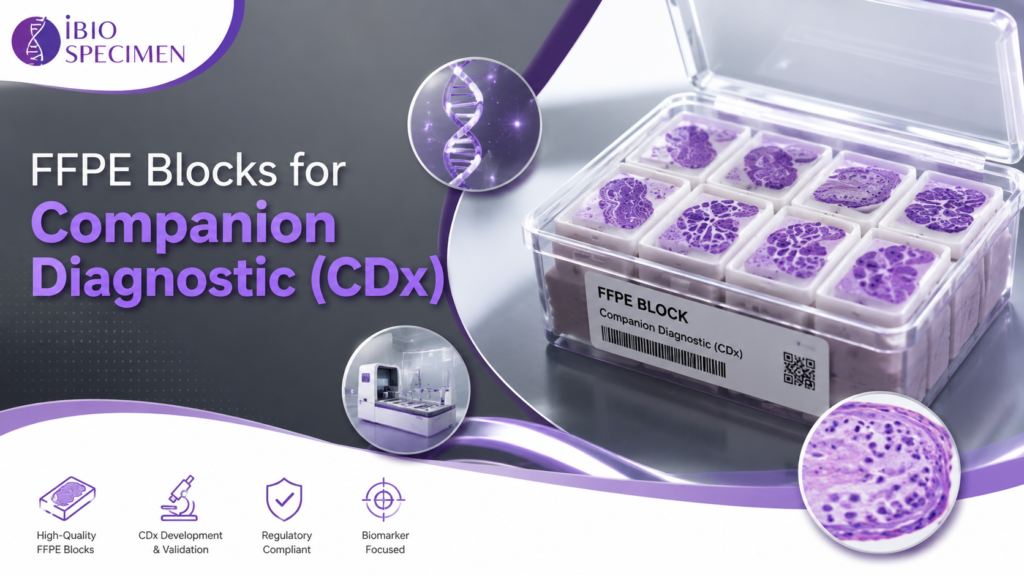
FFPE Blocks for Companion Diagnostic Development and Biomarker Qualification
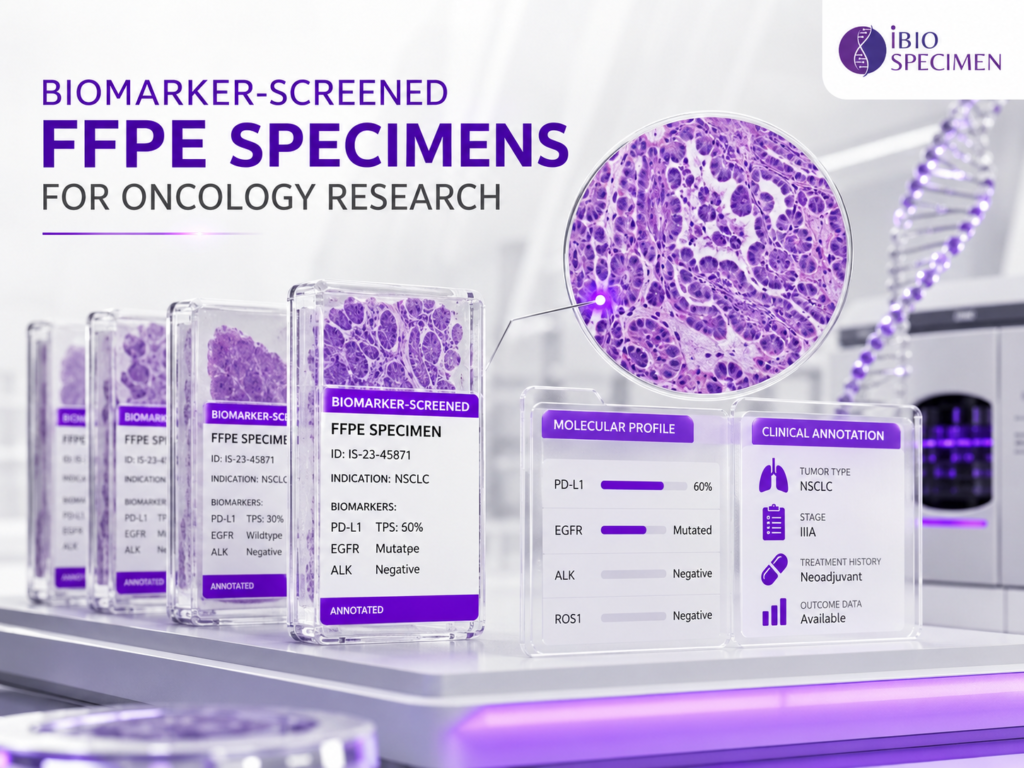
Formalin-fixed paraffin-embedded tissue is one of the most important sample formats used during oncology companion diagnostic development because it closely reflects the specimens encountered in routine pathology laboratories. Access to well-characterized FFPE blocks enables diagnostic developers, pharmaceutical companies, biotechnology organizations, and CROs to evaluate assay performance across clinically relevant tumor types, biomarker expression ranges, molecular alterations, and pathological characteristics.
FFPE blocks may support feasibility studies, assay optimization, antibody or probe selection, cut-off development, analytical validation, and bridging studies. Cohorts can be selected according to indication, tumor content, stage, grade, biomarker status, mutation profile, treatment history, and other available clinical variables. Where available, specimens may also be paired with H&E slides, pathology reports, IHC results, FISH data, PCR results, or NGS-based molecular characterization. A carefully selected FFPE cohort helps developers understand assay behavior under realistic pre-analytical conditions and supports robust companion diagnostic workflows for precision oncology programs.
Biomarker-Positive and Biomarker-Negative FFPE Blocks for CDx Assay Optimization
Effective companion diagnostic development requires more than simply obtaining tumor tissue. Developers frequently need samples distributed across the full biological range of the target biomarker, including strongly positive, weakly positive, borderline, heterogeneous, and negative cases. Biomarker-stratified FFPE blocks can help assay teams optimize analytical sensitivity, specificity, scoring algorithms, staining conditions, probe concentrations, sequencing thresholds, and interpretation criteria.
Depending on the program, cohorts may be selected using established IHC, ISH, FISH, PCR, or NGS results and can include clinically important alterations such as HER2 amplification, EGFR mutation, ALK or ROS1 rearrangement, KRAS mutation, BRAF mutation, PD-L1 expression, BRCA alterations, MSI status, or other oncology biomarkers. Access to molecularly and pathologically characterized tissue reduces the amount of screening required by sponsors and accelerates early assay development. Such specimens can also be valuable for evaluating discordant cases, low-prevalence biomarkers, analytical edge cases, and tumor heterogeneity before larger formal verification or validation studies.
Clinically Annotated FFPE Tumor Blocks for Oncology CDx Validation Programs
Clinical annotation significantly increases the value of FFPE tissue used in companion diagnostic programs. Depending on specimen availability and permitted data access, annotations may include diagnosis, histological subtype, tumor site, stage, grade, age, sex, specimen type, collection date, treatment history, response information, survival variables, and relevant molecular or immunohistochemical results. These variables allow sponsors to create cohorts that more accurately represent the intended-use population of the diagnostic assay.
For example, a lung cancer CDx program may require adenocarcinoma FFPE blocks with known EGFR, KRAS, ALK, ROS1, BRAF, MET, RET, or PD-L1 status, while a breast cancer program may focus on HER2, ER, PR, Ki-67, PIK3CA, or BRCA-associated disease. Carefully curated clinical and pathological data can help companies perform retrospective studies, assay concordance investigations, cut-off analysis, and exploratory clinical validation. Properly documented FFPE collections can therefore form an important foundation for translational research and regulated diagnostic development.
Custom FFPE Cohorts for Pharmaceutical and Companion Diagnostic Programs
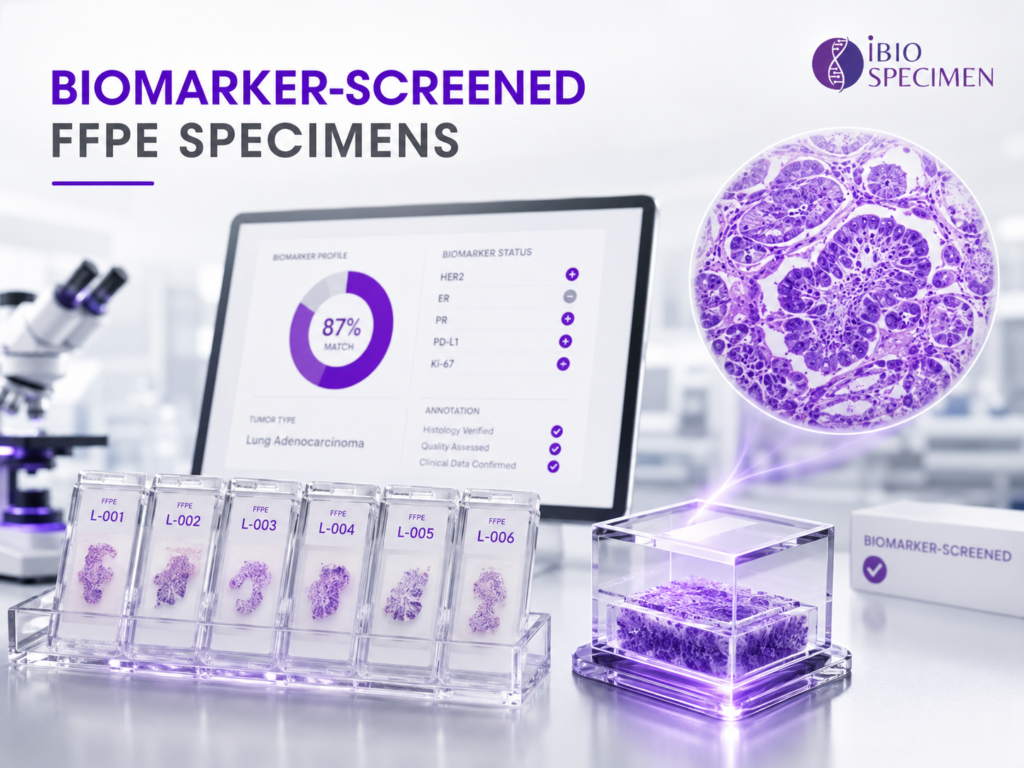
Companion diagnostic programs often require highly specific tissue profiles that cannot be fulfilled through generic biospecimen inventories. Custom FFPE cohort building enables sponsors to define exact inclusion and exclusion criteria based on cancer indication, specimen type, biomarker status, tumor percentage, necrosis level, block age, treatment exposure, disease stage, and associated clinical data. Cohorts may be assembled for pharmaceutical biomarker programs, diagnostic assay development, drug-response studies, retrospective clinical research, analytical validation, and prospective CDx investigations.
Sponsors may also request matched H&E slides, unstained sections, curls, DNA, RNA, or available molecular datasets from selected blocks. Large archives can be screened for rare molecular alterations or predefined biomarker combinations, allowing companies to enrich cohorts before shipment or downstream testing. This targeted sourcing model can substantially reduce internal screening effort and allows diagnostic developers to focus resources on assay performance, clinical interpretation, and regulatory development rather than specimen discovery.
General Questions
Frequent Asked Questions!!
FFPE blocks for genomics are formalin-fixed, paraffin-embedded tissue samples used for DNA, RNA, and biomarker analysis. They are widely used in cancer genomics, molecular pathology, translational research, and retrospective studies.
FFPE tissue blocks are valuable because they preserve tissue architecture and molecular material for long-term storage. Researchers can use them for sequencing, mutation analysis, biomarker discovery, and validation studies.
Yes. DNA can be extracted from FFPE blocks using validated extraction kits and optimized laboratory protocols. DNA quality depends on fixation time, block age, tissue type, tumor content, and storage conditions.
Yes. RNA can be extracted from FFPE tissue, although it is often fragmented because of formalin fixation. Specialized FFPE RNA extraction methods can provide material suitable for targeted RNA sequencing, gene expression studies, and fusion analysis.
Yes. High-quality FFPE blocks are commonly used for next-generation sequencing, including targeted sequencing panels, whole-exome sequencing, RNA sequencing, and selected whole-genome applications.
Tumor content requirements depend on the study design and testing method. Many molecular and NGS studies require at least 20% tumor content, while some projects may require 30%, 50%, or higher tumor percentage. Pathologist review can be performed to confirm tumor content before shipment
FFPE blocks can support mutation testing, copy number analysis, gene fusion detection, microsatellite instability testing, tumor mutational burden analysis, methylation studies, and targeted DNA or RNA sequencing.
Yes. FFPE cancer tissue blocks are extensively used to study genomic alterations in lung, breast, colorectal, prostate, ovarian, pancreatic, liver, kidney, and other tumor types.
Researchers can purchase FFPE blocks from qualified biospecimen suppliers, biobanks, pathology laboratories, hospitals, and research networks that provide ethically sourced and clinically annotated human tissue samples.
Researchers should confirm diagnosis, tissue type, tumor percentage, necrosis percentage, fixation details, block age, specimen size, available clinical data, pathology review, consent status, and intended research-use permissions.
Yes. Clinically annotated FFPE blocks may include donor age, sex, diagnosis, grade, stage, TNM classification, treatment history, pathology report, mutation status, and clinical outcome data.