
Introduction to
Clinical Trial Biospecimens

Protocol-Specific Biospecimens for Clinical Trial Research
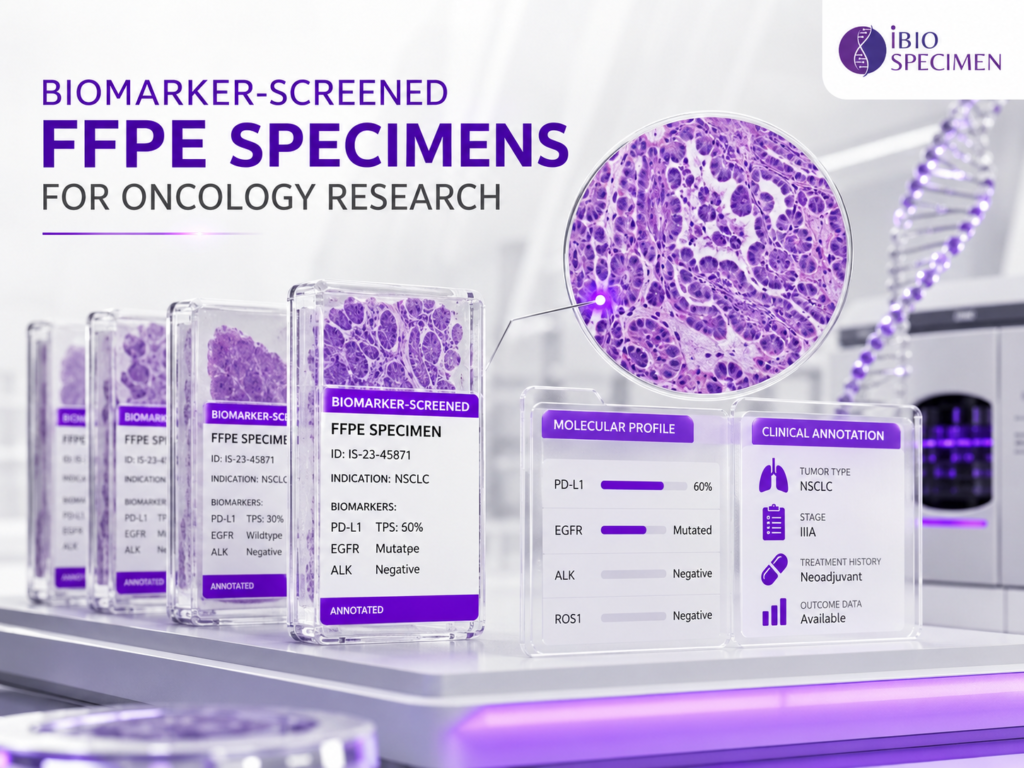
Clinical trial biospecimens provide the biological evidence needed to investigate treatment mechanisms, validate biomarkers, assess pharmacodynamic effects, and understand differences between responding and non-responding patients. We support pharmaceutical, biotechnology, diagnostic, and academic research organizations with protocol-specific specimen sourcing across oncology and other disease areas. Available sample types may include FFPE tissue, fresh frozen tissue, unstained slides, blood, plasma, serum, buffy coat, PBMCs, urine, saliva, and other human biological materials. Each collection is designed around the sponsor’s inclusion criteria, disease indication, trial phase, collection timepoints, sample-processing requirements, and associated data needs.
Clinical annotations may include diagnosis, stage, grade, treatment history, response status, collection timing, demographic information, and pathology results, subject to consent and data availability. Both retrospective and prospective sourcing models are available. By aligning sample selection, processing, documentation, and logistics with the clinical protocol, we help sponsors generate consistent biospecimen datasets that support translational endpoints and clinical-development decisions.
Prospective and Retrospective Clinical Trial Sample Collection
Sponsors may require archived samples for rapid retrospective analysis or newly collected biospecimens that follow a precise study schedule. Retrospective collections use existing specimens and associated clinical information to support feasibility studies, biomarker-prevalence analysis, assay development, and exploratory research. Prospective collections are designed around specific collection timepoints, such as baseline, during treatment, at surgery, after treatment, at progression, or during follow-up.
Prospective programs may involve newly diagnosed patients, treatment-naive cases, biomarker-defined populations, or patients receiving a specific therapy. Collection procedures can be standardized for sample type, processing time, storage temperature, fixation conditions, centrifugation, aliquoting, and shipping. Study-specific documentation may include sample manifests, pathology reports, collection worksheets, chain-of-custody records, and de-identified clinical datasets. Combining retrospective and prospective sourcing can provide early samples for assay development while building a longitudinal cohort for validation.
Biospecimens for Biomarker Discovery and Drug Development
Clinical trial samples are central to discovering biomarkers that predict treatment response, resistance, toxicity, disease progression, or patient prognosis. We help sponsors source biospecimens suitable for genomic, transcriptomic, proteomic, immunohistochemical, and spatial-analysis workflows. Collections can be defined around molecular alterations, protein expression, immune-cell patterns, clinical response, treatment exposure, or survival outcomes. Depending on the protocol, sponsors may request pre-treatment and post-treatment tissue, matched blood and tumor samples, longitudinal plasma, or samples from responders and non-responders.
Specimen formats can be selected to suit NGS, PCR, IHC, FISH, digital pathology, liquid biopsy, or exploratory multi-omics testing. Quality-control measures may include pathology confirmation, tumor-content assessment, sample-volume verification, processing review, and documentation of storage conditions. Carefully curated biospecimen cohorts allow research teams to connect biological findings with clinical outcomes and advance promising markers toward clinical validation, patient selection, and companion diagnostic development.
End-to-End Clinical Biospecimen Sourcing Support
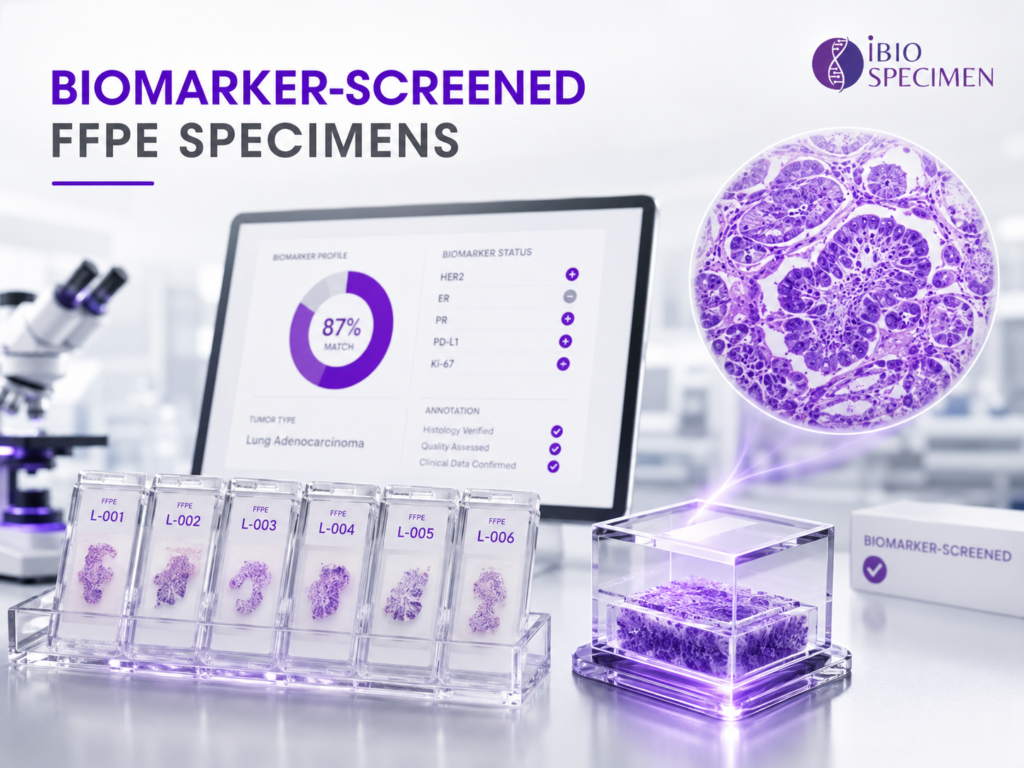
Successful clinical biospecimen programs require more than access to samples. They require careful planning, site coordination, ethical oversight, standardized collection, accurate documentation, and reliable shipment management. Our sourcing workflow begins with a detailed assessment of the study design, target population, required specimen types, collection schedule, laboratory specifications, and data fields.
We then evaluate feasibility and develop a customized sourcing strategy using retrospective archives, prospective collection sites, or a combined model. Support may include protocol refinement, case screening, pathology review, sample processing, data harmonization, de-identification, inventory management, and temperature-controlled logistics. Collection progress can be monitored against agreed milestones, with regular updates on screened, qualified, collected, and shipped cases. This coordinated model helps reduce operational burden for sponsors and CROs while improving sample consistency across locations.
General Questions
Frequent Asked Questions!!
FFPE blocks for genomics are formalin-fixed, paraffin-embedded tissue samples used for DNA, RNA, and biomarker analysis. They are widely used in cancer genomics, molecular pathology, translational research, and retrospective studies.
FFPE tissue blocks are valuable because they preserve tissue architecture and molecular material for long-term storage. Researchers can use them for sequencing, mutation analysis, biomarker discovery, and validation studies.
Yes. DNA can be extracted from FFPE blocks using validated extraction kits and optimized laboratory protocols. DNA quality depends on fixation time, block age, tissue type, tumor content, and storage conditions.
Yes. RNA can be extracted from FFPE tissue, although it is often fragmented because of formalin fixation. Specialized FFPE RNA extraction methods can provide material suitable for targeted RNA sequencing, gene expression studies, and fusion analysis.
Yes. High-quality FFPE blocks are commonly used for next-generation sequencing, including targeted sequencing panels, whole-exome sequencing, RNA sequencing, and selected whole-genome applications.
Tumor content requirements depend on the study design and testing method. Many molecular and NGS studies require at least 20% tumor content, while some projects may require 30%, 50%, or higher tumor percentage. Pathologist review can be performed to confirm tumor content before shipment
FFPE blocks can support mutation testing, copy number analysis, gene fusion detection, microsatellite instability testing, tumor mutational burden analysis, methylation studies, and targeted DNA or RNA sequencing.
Yes. FFPE cancer tissue blocks are extensively used to study genomic alterations in lung, breast, colorectal, prostate, ovarian, pancreatic, liver, kidney, and other tumor types.
Researchers can purchase FFPE blocks from qualified biospecimen suppliers, biobanks, pathology laboratories, hospitals, and research networks that provide ethically sourced and clinically annotated human tissue samples.
Researchers should confirm diagnosis, tissue type, tumor percentage, necrosis percentage, fixation details, block age, specimen size, available clinical data, pathology review, consent status, and intended research-use permissions.
Yes. Clinically annotated FFPE blocks may include donor age, sex, diagnosis, grade, stage, TNM classification, treatment history, pathology report, mutation status, and clinical outcome data.