
Introduction to
Biospecimen Provider in California

Human Biospecimen Provider Services for Research in California

Human Biospecimen Provider Services for Research in California. Define donor eligibility, specimen categories, and intended use before requesting quotations. Research teams working with California research institutes, biotechnology companies, and clinical collaborators benefit from a documented, method-led sourcing strategy. The search phrase “biospecimen provider in California” should describe a purchasing objective, not be read as proof that inventory is physically held in California. This overview offers selection considerations for research-use material and does not make unsupported claims about current stock, donor demographics, or accreditation.
Begin with the scientific question rather than a catalogue label. Investigators should specify whether the work is exploratory, assay development, comparative biomarker analysis, or a formally defined validation exercise. Each aim produces different demands for patient selection, number of specimens, clinical annotation, processing and release criteria. A clear written study brief makes vendor conversations more efficient and prevents an apparently suitable specimen from being unusable when it reaches the laboratory.
For human biospecimens, the term may include solid tissue, blood derivatives, isolated cells, biofluids, and pathology-prepared specimens. State the required form explicitly because identical disease labels do not imply interchangeable materials.
For a provider search in California, compare the actual fulfillment model: locally collected materials, globally sourced inventory, and custom prospective collection are different services. Ask which model applies to each requested specimen and whether the quoted documentation follows the material to the destination laboratory. Coordinate with California research institutes, biotechnology companies, and clinical collaborators when the project requires site-specific collection or specialized clinical review.
Sample selection should reflect the study design, including cases and controls, pre-treatment and post-treatment time points, and any planned stratification. Useful request fields can include diagnosis, tissue site, disease stage, age bracket, sex, collection date range and prior therapy, when these are ethically available. Avoid asking for identifiers that are unnecessary for the research question. Missing clinical fields should be represented as missing data rather than reconstructed or assumed.
For projects associated with California, account for US institutional review requirements, consent permissions, and applicable privacy safeguards. Work with qualified institutional teams to determine which permissions and contracts apply to the specific specimens, intended tests and movement of data. For delivery, consider interstate domestic delivery and temperature-sensitive freight planning. Requirements can change depending on origin, destination, material classification and research use; confirm them case by case.
Specify what is acceptable and what causes rejection before ordering. Consider minimum volume or tissue dimensions, sample count, permitted freeze-thaw exposure, storage duration, and whether matched materials are necessary. If a study uses multiple laboratories, write down one common accession and labeling convention. Request a sample manifest early so receiving staff can plan the actual workflow, not merely confirm the quantity on a purchase order.
The provider evaluation should focus on end-to-end sourcing support, clinical feasibility checks, case selection, record completeness, and the level of coordination available after delivery. Document whether the organization is the collecting institution, an authorized distributor, or a sourcing intermediary. That distinction affects where records originate, how availability is confirmed, and which responsibilities belong in the transfer agreement.
Quality Documentation and Traceability for California Biospecimens
Quality Documentation and Traceability for California Biospecimens. Assess provenance, processing records, pathology details, and labeling consistency. Research teams working with California research institutes, biotechnology companies, and clinical collaborators benefit from a documented, method-led sourcing strategy. The search phrase “biospecimen provider in California” should describe a purchasing objective, not be read as proof that inventory is physically held in California. This overview offers selection considerations for research-use material and does not make unsupported claims about current stock, donor demographics, or accreditation.
A quality review begins with provenance and a documented handling history. Ask which collection and processing steps are recorded, how identifiers are coded, what storage equipment was used, and which material-specific release tests are available. An attractive inventory summary does not substitute for an auditable record. The required depth of documentation depends on assay sensitivity and the consequences of a failed specimen.
Disease-specific sourcing can involve scarce cohorts, restrictive inclusion criteria, or incomplete metadata. Feasibility discussions should therefore separate confirmed inventory from potential prospective collection and indicate which fields can realistically be delivered.
For a provider search in California, compare the actual fulfillment model: locally collected materials, globally sourced inventory, and custom prospective collection are different services. Ask which model applies to each requested specimen and whether the quoted documentation follows the material to the destination laboratory. Coordinate with California research institutes, biotechnology companies, and clinical collaborators when the project requires site-specific collection or specialized clinical review.
Preanalytical variation can influence downstream findings. Collection-to-processing intervals, fixatives or anticoagulants, transport conditions, storage temperatures, and repeated thawing can all matter, although their relevance differs by analyte. Establish a practical checklist that distinguishes essential information from optional context. When documentation is incomplete, decide whether a sample remains suitable for pilot research instead of treating all missing fields as equivalent.
For projects associated with California, account for US institutional review requirements, consent permissions, and applicable privacy safeguards. Work with qualified institutional teams to determine which permissions and contracts apply to the specific specimens, intended tests and movement of data. For delivery, consider interstate domestic delivery and temperature-sensitive freight planning. Requirements can change depending on origin, destination, material classification and research use; confirm them case by case.
Plan a receiving inspection for every delivery. Reconcile the manifest against tube or block labels, inspect packaging, note temperature indicator information when provided, and document discrepancies immediately. After accessioning, route aliquots or sections through a defined chain of custody. These controls protect the research record and help laboratories troubleshoot outlying assay results without guessing how a specimen was handled before arrival.
The provider evaluation should focus on end-to-end sourcing support, clinical feasibility checks, case selection, record completeness, and the level of coordination available after delivery. Document whether the organization is the collecting institution, an authorized distributor, or a sourcing intermediary. That distinction affects where records originate, how availability is confirmed, and which responsibilities belong in the transfer agreement.
Choosing Human Tissue and Biosample Types for California Studies
Choosing Human Tissue and Biosample Types for California Studies. Match matrices, collection windows, and assay requirements to a defensible protocol. Research teams working with California research institutes, biotechnology companies, and clinical collaborators benefit from a documented, method-led sourcing strategy. The search phrase “biospecimen provider in California” should describe a purchasing objective, not be read as proof that inventory is physically held in California. This overview offers selection considerations for research-use material and does not make unsupported claims about current stock, donor demographics, or accreditation.
Different experimental methods impose different specimen requirements. Morphology-based studies emphasize representative tissue architecture and annotation; molecular profiling may emphasize nucleic-acid integrity and sufficient material; soluble-marker studies prioritize the appropriate collection matrix and processing conditions. Ask the analytical team to identify the minimum usable material for each planned endpoint. A single specimen type should not be advertised as universally suitable for every platform.
A biospecimen catalogue should make sample type, diagnosis and research-use restrictions understandable without implying that clinical use, diagnostic suitability or treatment decisions are authorized.
For a provider search in California, compare the actual fulfillment model: locally collected materials, globally sourced inventory, and custom prospective collection are different services. Ask which model applies to each requested specimen and whether the quoted documentation follows the material to the destination laboratory. Coordinate with California research institutes, biotechnology companies, and clinical collaborators when the project requires site-specific collection or specialized clinical review.
Matched or serial materials may create more value than additional unrelated specimens. Where permitted and available, researchers can request paired disease and adjacent tissue, baseline and follow-up material, or linked blood fractions to investigate orthogonal readouts. Pairing and matching should be confirmed in the documentation rather than inferred from similar metadata. Define how the study will handle incomplete pairs before purchasing.
For projects associated with California, account for US institutional review requirements, consent permissions, and applicable privacy safeguards. Work with qualified institutional teams to determine which permissions and contracts apply to the specific specimens, intended tests and movement of data. For delivery, consider interstate domestic delivery and temperature-sensitive freight planning. Requirements can change depending on origin, destination, material classification and research use; confirm them case by case.
Small feasibility sets can test extraction yield, assay signal, staining specificity and batch effects before a larger acquisition. A pilot also reveals whether the supplied annotations map cleanly to the research database. Record limitations such as small cohort size, sampling bias or variable collection protocols; doing so strengthens interpretation and provides a factual basis for a later expanded sourcing request.
The provider evaluation should focus on end-to-end sourcing support, clinical feasibility checks, case selection, record completeness, and the level of coordination available after delivery. Document whether the organization is the collecting institution, an authorized distributor, or a sourcing intermediary. That distinction affects where records originate, how availability is confirmed, and which responsibilities belong in the transfer agreement.
Procurement, Ethics, and Delivery of Research Biospecimens in California
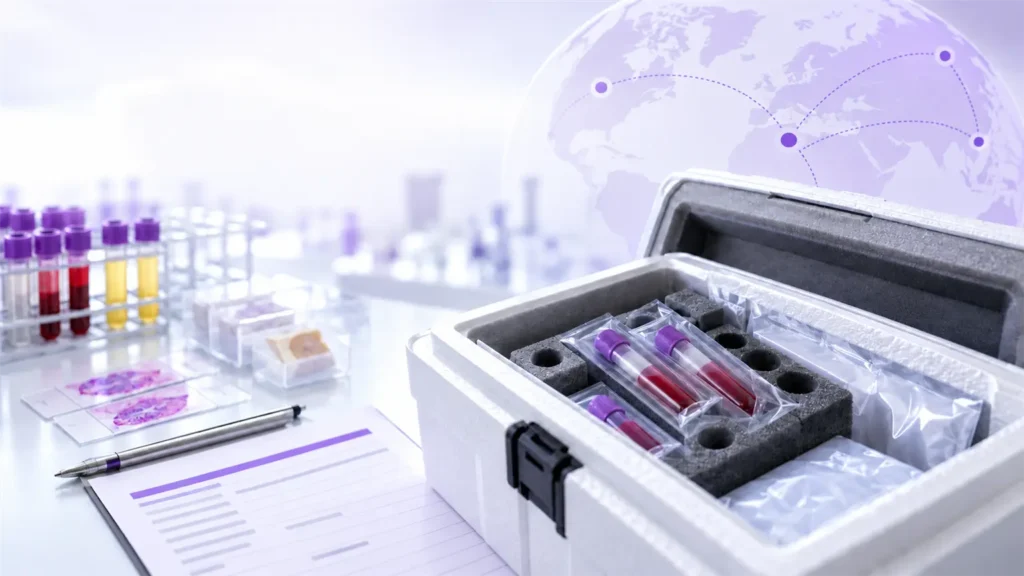
Procurement, Ethics, and Delivery of Research Biospecimens in California. Plan institutional review, material transfer, packaging, and receipt ahead of purchase. Research teams working with California research institutes, biotechnology companies, and clinical collaborators benefit from a documented, method-led sourcing strategy. The search phrase “biospecimen provider in California” should describe a purchasing objective, not be read as proof that inventory is physically held in California. This overview offers selection considerations for research-use material and does not make unsupported claims about current stock, donor demographics, or accreditation.
Sourcing human biological materials requires both scientific and administrative checks. The purchasing organization should identify the required ethics approval or exemption determination, the permitted downstream uses, restrictions on redistribution, and any donor-consent limitations. These details vary across institutions and jurisdictions. Do not assume that a supplier can provide unrestricted access merely because a catalogue lists a specimen category.
For human biospecimens, the term may include solid tissue, blood derivatives, isolated cells, biofluids, and pathology-prepared specimens. State the required form explicitly because identical disease labels do not imply interchangeable materials.
For a provider search in California, compare the actual fulfillment model: locally collected materials, globally sourced inventory, and custom prospective collection are different services. Ask which model applies to each requested specimen and whether the quoted documentation follows the material to the destination laboratory. Coordinate with California research institutes, biotechnology companies, and clinical collaborators when the project requires site-specific collection or specialized clinical review.
Commercial discussions should define unit of sale, minimum order quantity, availability, inclusion criteria, clinical-data fields, replacement policy, lead times, and material transfer responsibilities. Request clarity on what documentation accompanies the shipment and what is available only under a separate agreement. An order is more manageable when acceptance criteria and remedies for shortages or nonconformities appear in writing.
For projects associated with California, account for US institutional review requirements, consent permissions, and applicable privacy safeguards. Work with qualified institutional teams to determine which permissions and contracts apply to the specific specimens, intended tests and movement of data. For delivery, consider interstate domestic delivery and temperature-sensitive freight planning. Requirements can change depending on origin, destination, material classification and research use; confirm them case by case.
Operational planning continues after supplier selection. Establish transport classification, packaging, temperature regime, destination permits where relevant, import and export formalities, and procedures for delayed deliveries. On receipt, retain the manifest, transfer documents and QC findings alongside the project record. The objective is not a promise of immediate availability; it is a transparent process that supports reproducible and ethically appropriate research.
The provider evaluation should focus on end-to-end sourcing support, clinical feasibility checks, case selection, record completeness, and the level of coordination available after delivery. Document whether the organization is the collecting institution, an authorized distributor, or a sourcing intermediary. That distinction affects where records originate, how availability is confirmed, and which responsibilities belong in the transfer agreement.
General Questions
Frequent Asked Questions!!
FFPE blocks for genomics are formalin-fixed, paraffin-embedded tissue samples used for DNA, RNA, and biomarker analysis. They are widely used in cancer genomics, molecular pathology, translational research, and retrospective studies.
FFPE tissue blocks are valuable because they preserve tissue architecture and molecular material for long-term storage. Researchers can use them for sequencing, mutation analysis, biomarker discovery, and validation studies.
Yes. DNA can be extracted from FFPE blocks using validated extraction kits and optimized laboratory protocols. DNA quality depends on fixation time, block age, tissue type, tumor content, and storage conditions.
Yes. RNA can be extracted from FFPE tissue, although it is often fragmented because of formalin fixation. Specialized FFPE RNA extraction methods can provide material suitable for targeted RNA sequencing, gene expression studies, and fusion analysis.
Yes. High-quality FFPE blocks are commonly used for next-generation sequencing, including targeted sequencing panels, whole-exome sequencing, RNA sequencing, and selected whole-genome applications.
Tumor content requirements depend on the study design and testing method. Many molecular and NGS studies require at least 20% tumor content, while some projects may require 30%, 50%, or higher tumor percentage. Pathologist review can be performed to confirm tumor content before shipment
FFPE blocks can support mutation testing, copy number analysis, gene fusion detection, microsatellite instability testing, tumor mutational burden analysis, methylation studies, and targeted DNA or RNA sequencing.
Yes. FFPE cancer tissue blocks are extensively used to study genomic alterations in lung, breast, colorectal, prostate, ovarian, pancreatic, liver, kidney, and other tumor types.
Researchers can purchase FFPE blocks from qualified biospecimen suppliers, biobanks, pathology laboratories, hospitals, and research networks that provide ethically sourced and clinically annotated human tissue samples.
Researchers should confirm diagnosis, tissue type, tumor percentage, necrosis percentage, fixation details, block age, specimen size, available clinical data, pathology review, consent status, and intended research-use permissions.
Yes. Clinically annotated FFPE blocks may include donor age, sex, diagnosis, grade, stage, TNM classification, treatment history, pathology report, mutation status, and clinical outcome data.