In the era of spatial transcriptomics and whole-transcriptome sequencing, the value of a biospecimen is no longer measured solely by its pathology report. Today, the most critical data point for a molecular biologist is the RNA quality profile.
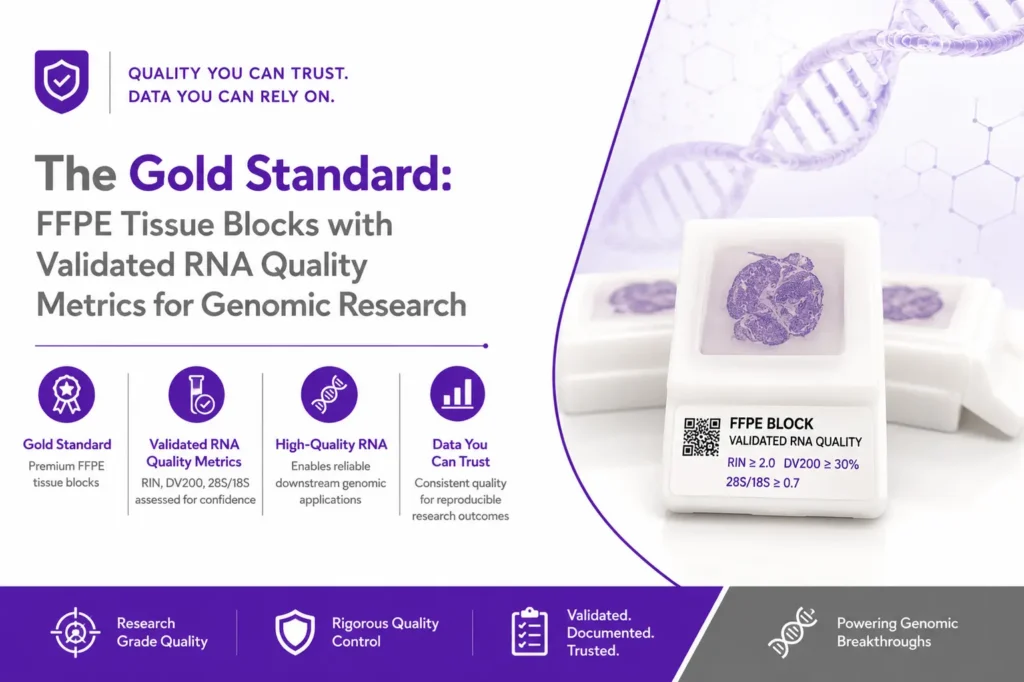
Sourcing FFPE tissue blocks with RNA quality metrics—specifically RIN (RNA Integrity Number) and DV200 scores—is essential for ensuring that your Next-Generation Sequencing (NGS) libraries are successful, reproducible, and representative of the true biological state of the tumor.
1. The Challenge of RNA Extraction from FFPE Tissue
Formalin fixation is designed to preserve cellular morphology, not molecular integrity. The process involves the creation of methylene bridges between proteins and nucleic acids.
For RNA, this results in:
- Chemical Modification: Formalin adds methylol groups to RNA bases, which can interfere with reverse transcription.
- Fragmentation: Over time, especially in poorly stored blocks, RNA strands break into shorter fragments.
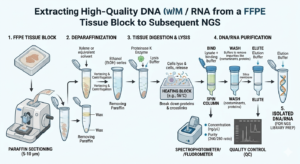
- Low Yield: Without specialized extraction protocols, much of the RNA remains “locked” within the cross-linked paraffin matrix.
Why Quality Metrics Matter
If you attempt to sequence RNA from a block with poor integrity, you risk “Sequencing Bias,” where only the most stable transcripts are detected, leading to a false representation of gene expression.
By purchasing blocks with pre-validated metrics, you eliminate the risk of sequencing failure before you even start your library preparation.
2. Understanding the Metrics: RIN vs. DV200
When evaluating FFPE samples for RNA-Seq, researchers typically look at two primary metrics. At ibiospecimen.com, we provide both to ensure complete transparency.
The RIN Score (RNA Integrity Number)
The RIN score ranges from 1 (totally degraded) to 10 (completely intact) and is calculated based on the ratio of 28S to 18S ribosomal RNA.
The FFPE Reality
- Fresh-frozen tissue often yields RIN scores of 7–9
- FFPE tissue typically scores between 2 and 5
Limitations
Because FFPE RNA is inherently fragmented, a low RIN score does not necessarily mean the sample is unusable—it is often expected for FFPE-preserved tissue.
The DV200 Score: The NGS Gold Standard
The DV200 metric is specifically designed for FFPE RNA. It calculates the percentage of RNA fragments greater than 200 nucleotides in length.
| DV200 Score | Interpretation | Recommended Use |
| >70% | High Quality | Ideal for Whole Transcriptome Sequencing |
| 50%–70% | Medium Quality | Suitable for targeted panels and many spatial platforms |
| 30%–50% | Low Quality | May require specialized low-input library kits |
| <30% | Unsuitable | High risk of library failure |
3. Pre-Analytical Excellence: How We Guarantee RNA Quality
The “life” of the RNA in your sample is determined in the first hour after surgery. We implement a rigorous cold chain of custody to ensure the highest possible DV200 scores.
I. Cold Ischemia Time Management
RNA begins to degrade the moment blood flow stops. We mandate a Cold Ischemia Time (CIT) of less than 60 minutes.
By rapidly chilling the tissue or moving it immediately to fixation, we halt the action of endogenous RNases (enzymes that degrade RNA).
II. Neutral Buffered Formalin (NBF) Optimization
The pH of the fixative matters. We use only 10% Neutral Buffered Formalin (pH 7.0–7.4).
Acidic formalin causes rapid acid hydrolysis of RNA, leading to severe fragmentation.
III. Optimized Fixation Windows
- Under-fixation leaves the center of the tumor vulnerable to autolysis.
- Over-fixation creates excessive cross-links, making RNA extraction difficult.
We optimize fixation windows between 12 and 24 hours for standard biopsies and resections.
4. Featured Inventory with RNA Characterization
We maintain a diverse worldwide inventory of FFPE blocks specifically curated for high-input genomic projects.
A. Non-Small Cell Lung Cancer (NSCLC)
- Metrics: Average DV200 of 65%
- Annotation: Included NGS reports for EGFR, ALK, and KRAS
- Research Use: Ideal for studying resistance mechanisms in patients who have failed TKI therapy
B. Metastatic Breast Cancer
- Metrics: High-yield RNA extraction blocks (average yield >100 ng/μl)
- Annotation: ER/PR/HER2 IHC status included
- Research Use: Targeted for the development of new Antibody-Drug Conjugates (ADCs)
C. Rare Gastrointestinal Tumors (GIST & CCA)
- Metrics: Specialized EDTA-decalcified blocks for bone-metastasized samples to preserve RNA
- Research Use: Discovery of rare gene fusions such as FGFR2 and NTRK
5. Applications in Advanced Genomic Technologies
Your choice of tissue depends on your downstream platform. Our RNA-validated FFPE blocks are compatible with leading genomic technologies.
1. Spatial Transcriptomics (10x Genomics Visium & NanoString GeoMx)
These platforms often require a minimum DV200 score greater than 50% to ensure proper probe hybridization.
By purchasing pre-screened blocks, you protect your investment in high-cost experiments.
2. Whole Exome Sequencing (WES) & RNA-Seq
For researchers performing multi-omics studies, we provide:
- Thick tissue scrolls
- High-cellularity blocks
- Material optimized for simultaneous DNA and RNA workflows
3. AI Foundry & Digital Pathomics
These blocks serve as biological ground truth datasets.
By pairing:
- High-resolution digital pathology scans
- Verified RNA expression profiles
researchers can train AI models to predict genomic signatures directly from H&E images.
6. Comprehensive Documentation: The “ibiospecimen” Certificate
When you procure from ibiospecimen.com, you receive a complete digital data package for every block.
Included Documentation
- Pathology Report: Verified diagnosis and stage
- Qubit/NanoDrop Data: Total RNA yield and concentration
- Bioanalyzer/TapeStation Report: Electropherogram showing RNA size distribution
- Calculated DV200: The critical go/no-go metric for NGS workflows
7. Ethical Standards and Global Supply Chain
As a global supplier, we adhere to international ethical and regulatory standards.
Ethical Compliance
- Informed donor consent for biomedical research use
- HIPAA and GDPR compliant workflows
- Pseudonymized identifiers for patient anonymity
Logistics & Storage
We utilize:
- Temperature-controlled shipping
- Data logger monitoring
- Climate-controlled storage environments
to prevent heat-induced RNA degradation during transit and storage.
8. Why ibiospecimen.com is Your Strategic Biotech Partner
As a biotech leader, efficiency and data integrity matter.
We Offer
Prospective RNA Validation
Have a cohort in mind? We can perform RNA extraction and quality testing on a per-block basis before purchase.
Matched Sample Sets
We provide:
- Tumor FFPE blocks
- Normal adjacent tissue (NAT)
- Matched plasma/liquid biopsy samples
for concordance and translational studies.
Expert Consultation
Our molecular biologists can help optimize sample selection based on your preferred library preparation chemistry, including:
- Illumina Stranded
- NEBNext
- Low-input RNA workflows
Data-Driven Procurement for Precision Oncology
The era of blind tissue procurement is over.
To drive discovery in precision oncology, researchers need biological materials that are as data-rich as the assays they run.
By providing FFPE tissue blocks with validated RNA quality metrics, ibiospecimen.com removes uncertainty from genomic research and enables scientists to focus on discovery, translational science, and therapeutic innovation.
Frequently Asked Questions (FAQs)
Q: What is a “good” DV200 score for Whole Transcriptome Sequencing?
A: Most labs target a DV200 of $>50\%$. Samples with a score between $30\%$ and $50\%$ can still be sequenced but may require more cycles of PCR or specialized “ribosomal depletion” kits.
Q: How do you prevent RNA degradation in stored blocks?
A: We store our inventory in climate-controlled, low-humidity environments. For long-term preservation of RNA, we recommend that blocks be kept at room temperature in a stable environment and never exposed to temperatures above 25°C.
Q: Can you provide “scrolls” for RNA extraction instead of the whole block?
A: Yes. We can provide 10μm or 20μm scrolls in DNA/RNA-free tubes, allowing your lab to start extraction immediately upon delivery.